Merit Shop Votes Matter
Merit Shop Workers Built the GOP Coalition
A new survey shows merit shop workers consistently back Republicans while skilled tradespeople nationwide support fair and open competition, regardless of union or nonunion membership.
An ABC-commissioned survey conducted by The Harris Poll in six battleground states confirms that merit shop skilled trades workers represent one of the most reliable and Republican-aligned constituencies in the modern electorate. Across measures of party alignment, candidate support and policy preferences, merit shop workers in the trades consistently align more closely with the GOP than their union counterparts.
Much has been made of President Donald Trump’s broad working-class coalition and its importance to the Republican party. This realignment is the defining political story of the moment. And as the Harris survey results show, the 2024 election was indeed won by the working class. However, a closer look at the data also reveals that it was the merit shop—the overwhelming share of American tradespeople who choose not to belong to a union—powering Trump’s blue-collar victory.
While the working-class identity is often conflated with union affiliation, the data show that merit shop construction workers not only voted for President Trump at a significantly higher rate in 2024—they also continue to approve more strongly of his performance in office. And merit shop workers outnumber union workers in the states that matter, comprising from three to 65 times greater share of the electorate.
Taken together, the findings demonstrate that merit shop workers are not a marginal or emerging group; they are a core pillar of the GOP’s coalition in swing states, where election outcomes are decided by the narrowest of margins.
Political Alignment With the GOP
Merit shop skilled trades workers show significantly stronger alignment with the Republican Party and President Trump than union workers, reinforcing their role as an indispensable base of GOP electoral support.
In the 2024 presidential election: 69% of merit shop skilled trades workers reported supporting President Trump, compared to 57% of union skilled trades workers.
Merit shop support for President Trump exceeded union support across all six swing states:
- Sun Belt (Arizona, Georgia, North Carolina): Merit shop workers supported President Trump at a rate 19 points higher than union workers (+19 advantage).
- Rust Belt (Michigan, Pennsylvania, Wisconsin): Merit shop workers supported President Trump at a rate 7 points higher than union workers (+7 advantage).
Merit shop and union workers share similar occupations and economic conditions, yet merit shop workers are consistently more aligned with President Trump and Republicans, suggesting that policy preferences, not class or trade, are the primary drivers of this divide .
Merit Shop Skilled Trades Workers Determine GOP Success in Swing States
In an industry of 9 million construction workers nationwide, 9 out of 10 do not belong to a union. In swing states, merit shop workers dominate the market, and in three, they represent more than 96% of construction workers.
State-by-state breakdown of merit shop skilled trades worker density:

Merit shop skilled trades workers are not only essential to the Republican coalition in swing states that decide elections, but they also vastly outnumber union skilled trades workers in those states. Therefore, pursuing national policies that alienate these workers across the board is political malpractice.
Skilled Trades Workers Oppose Union Preferences in Federal Contracting

The survey also reveals broad opposition to explicit union favoritism in federal construction contracting.
- 60% of respondents believe the federal government should not base contract awards on whether a contractor is signatory to a union.
- Only 30% believe union contractors should be favored.
This 2-to-1 margin of opposition signals that union-preferred policies are out of step not only with merit shop workers but with skilled trades workers broadly, including many union members themselves.
Informed Respondents Increasingly Oppose PLA Mandates
Opposition to project labor agreement mandates intensifies as respondents become more informed about how these mandates function.
After respondents were provided detailed information about PLA mandates:

As workers learn more about how PLA mandates actually function—restricting competition and limiting contractor participation—opposition grows. This is true not only among merit shop workers, but across the broader skilled trades workforce.
Skilled Trades Workers Strongly Support Fair and Open Competition
Support for fair and open competition is broad, bipartisan and deeply rooted among construction workers, regardless of union affiliation.
When asked whether the federal government should have the flexibility to select contractors based on best value for taxpayers, rather than union affiliation:
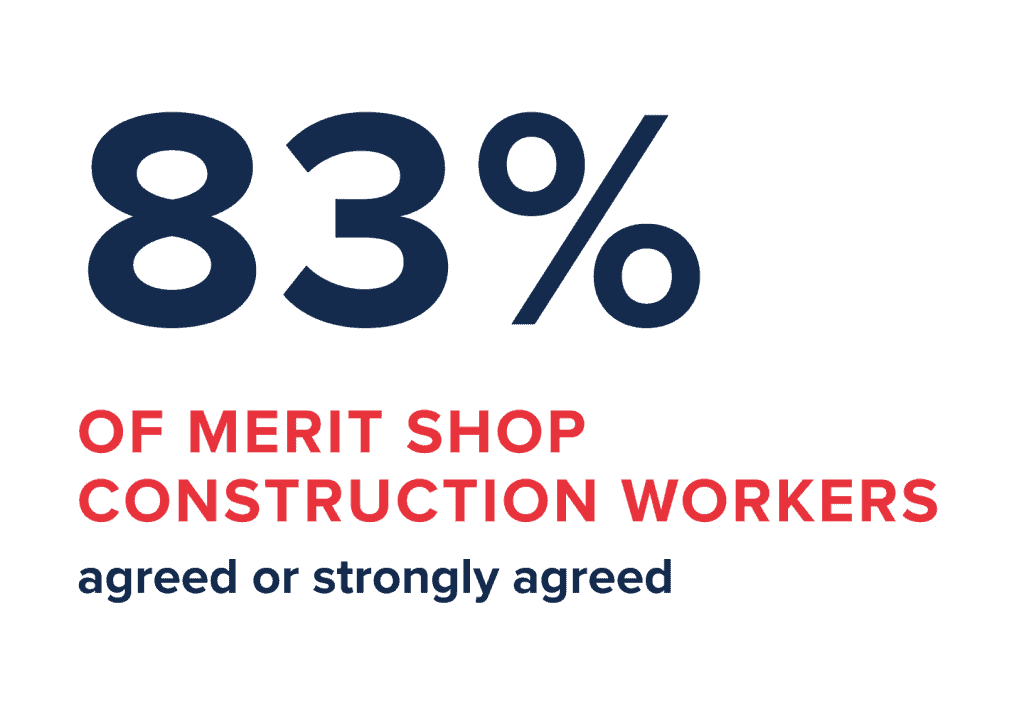
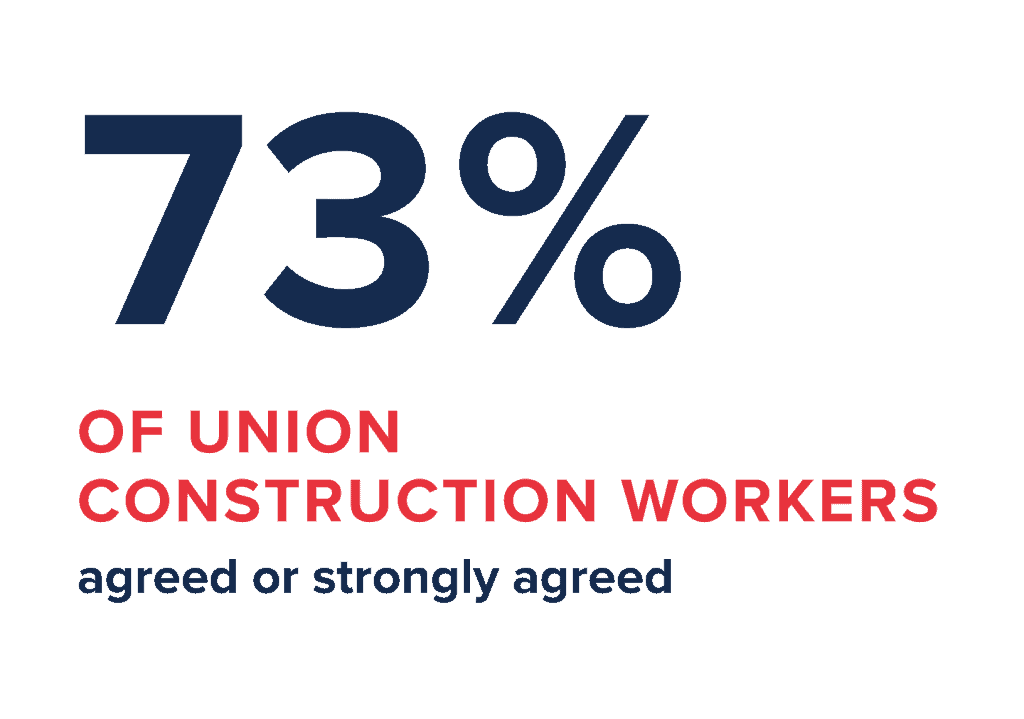
Support for competitive contracting is a consensus position across the trades workforce, regardless of union affiliation. Even among union members, a clear majority favors a system that prioritizes performance, cost efficiency and taxpayer value over union preferences.
Implications for the GOP
The administration has an opportunity to align federal contracting policy with the clearly expressed preferences of the workers who powered its 2024 victory. Continued support for PLA mandates risks signaling an alignment with union leadership rather than rank-and-file workers , including the merit shop workers who overwhelmingly supported President Trump in 2024.
By endorsing policies that limit competition, PLA mandates risk alienating a workforce that forms a critical part of the GOP’s electoral base, particularly in swing states where merit shop workers play an outsized role. Rather than advancing a pro-worker, pro-taxpayer agenda, PLA mandates prioritize illusory political alliances over economic fairness, workforce opportunity and taxpayer value.
Supporting true worker freedom means embracing open competition, a policy approach that empowers skilled workers, rewards performance and reflects the clearly expressed preferences of the construction workforce.
The 2026 generic congressional ballot data reinforce the point: merit shop skilled trades workers favor Republicans by a 2-to-1 margin (51% Republican vs. 24% Democrat), with a large pool of undecided merit shop voters still in play. By contrast, union skilled trades workers gave the GOP just a 10-point edge (43% to 33%).
In the 2026 midterms and beyond, Republicans who embrace fair and open competition will see continued support from the majority of skilled trades workers in their states and districts. Those who support government-mandated project labor agreements in the hope that appeasing union bosses will win over rank-and-file workers are chasing a bargain the data show doesn’t exist.